Trust Has to Be Taught, Not Assumed
One of the earliest and most consistent takeaways was how fragile trust has become in residential construction.
We talk constantly about collaboration and “team approaches,” but too often we treat those ideas as self-explanatory. They’re not. In a world where homeowners have unlimited access to information and misinformation, you can’t assume they understand why alignment across architects, builders, and consultants matters.
If we don’t actively educate clients on how teams work best together, the system defaults to something else: quiet competition. Teams jockey for influence. Decisions get filtered. Communication fragments. And the work suffers.
Trust today doesn’t come from credentials alone. It has to be explained, modeled, and reinforced. That’s not the client’s responsibility. It’s an industry obligation.
Calm Is in Control. Control Feels Calm.
Another principle that stayed with me came from a simple observation: some projects feel easy not because they’re small or simple, but because of who’s involved.
Truly excellent work has a calmness to it. Not passive calm, but prepared calm. The kind that comes from clarity, foresight, and discipline.
Clients want to feel in control of the process. Architects need it. Builders are expected to provide it. And what I’ve learned is that real control doesn’t look loud or reactive. It looks thoughtful. It looks solution-oriented. It looks composed under pressure.
Calm isn’t a personality trait. It’s a professional discipline. And it’s one of the clearest indicators that a team knows what it’s doing.
Listening Is a Form of Leadership
This one required some personal reflection.
There are moments where it’s tempting, especially as a builder with strong opinions, to push details or decisions because they align with a firm’s standards or a vision of what “good” looks like.
Sometimes that’s appropriate. There are projects where clients are explicitly asking for that level of assertion and leadership.
But not every project benefits from it.
Some of the best outcomes come from listening more than asserting but by taking the time to understand what a client actually wants, not what we assume they should want. Building great homes isn’t about imposing a vision. It’s about interpreting one accurately.
That takes humility. It takes restraint. And it requires separating ego from service.
Disciplined Design Beats Accidental Creativity
One phrase we’ve developed internally captures a lot of this thinking: the best projects are disciplined design executed at the highest level.
“Disciplined” doesn’t mean conservative. It means intentional.
Great work doesn’t happen by accident. The process has to be intentional. The decisions have to be intentional. The execution has to be intentional. Creativity without discipline is noise. Discipline without creativity is lifeless. The best projects demand both.
This is what modern building requires, not shortcuts or heroics, but thoughtful systems that support creativity rather than undermine it.
Alignment Makes Better Work
Another clear pattern emerged: the quality of the work improves dramatically when builders are treated as creative partners rather than just executors.
When there’s mutual respect between disciplines, when architects, builders, and consultants trust each other’s expertise, the results speak for themselves. Details get sharper. Problems get solved earlier. The work feels cohesive instead of negotiated.
But that alignment doesn’t happen by chance. It starts with the owner, and it depends on education and clarity from the very beginning.
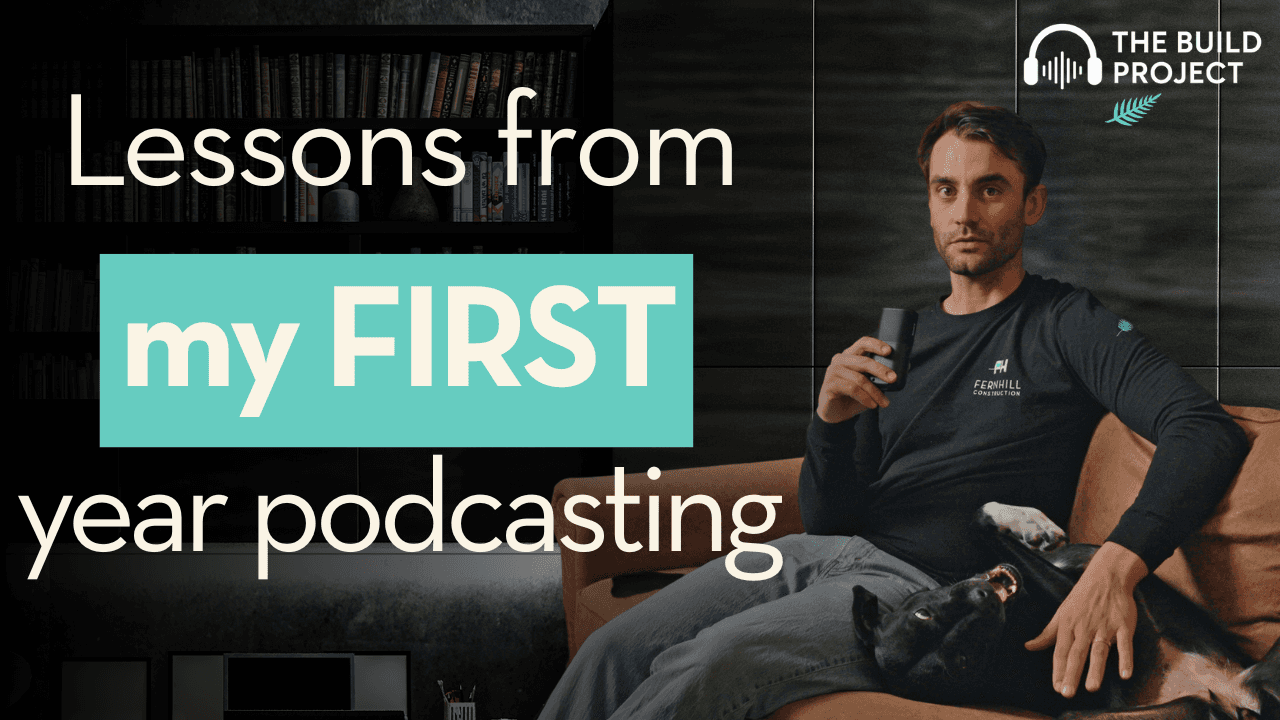
That’s part of why the podcast exists. It’s part of a broader effort to make the process more transparent, more honest, and more collaborative.
Wanting to Be Challenged by Meaningful Problems
The biggest realization, though, was personal.
I set out with the goal of building the coolest work possible, not as a statement about scale or budget, but about intention, craft, and care. And I’ve learned that if I’m not doing that in some capacity, if I’m not being challenged to solve meaningful problems - I’d rather do something else.
That challenge can take many forms. Sometimes it’s about efficiency. Sometimes it’s about sustainability. Sometimes it’s about budget discipline. Sometimes it’s about pushing an architectural idea further.
The point is that it’s complicated. And complexity demands intention. Intention demands trust.
A Clearer Way Forward
The first year of the podcast didn’t teach me how to be louder. It taught me how to be clearer about values, standards, and the kind of work worth pursuing.
Clarity builds trust. And trust is what allows good teams to do great work.
That’s the direction I’ll keep moving in.